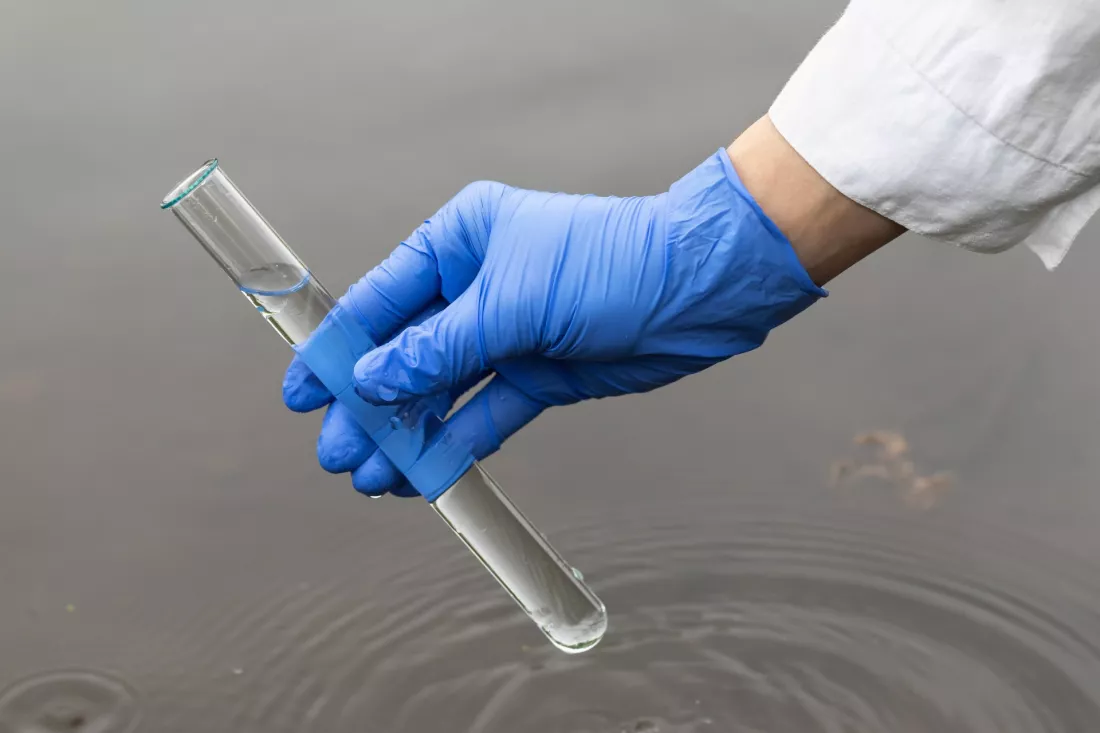
Fish farming is booming, yet only 37% of Europe’s surface waters meet environmental requirements. SusWater tackled this with an unusual toolkit: filters made from cellulose, chitosan, starch and gelatine, fungi taken from wastewater, light-driven catalysts and a pocket-sized sensor for trace pollutants. It is a field where chemists, biologists and materials scientists work side by side – and at the end you can check whether you have what it takes to be a clean-water detective.
When people think about food production, they usually picture fields, orchards or cattle. Aquaculture – the farming of fish and other aquatic organisms – rarely comes to mind first, even though it is one of the fastest growing food-producing industries. There is a catch, though: a fish farm is only as good as the water that flows into it. Availability and quality of water decide whether the animals grow healthy or not.
That is where the trouble starts. Only 37% of Europe’s surface waters meet environmental requirements, which means water pollution is becoming an ever bigger challenge. Rivers and lakes carry traces of metals, medicines and other substances that nobody wants on their dinner plate.
The EU-funded SusWater project set out to change that. It brought together a consortium of nine partners from three continents to develop tools for monitoring and treating polluted water, with a special focus on supplying safe water for aquaculture.
What made the team work was the mix of skills. The partners covered analytical and environmental chemistry, materials science, biology, toxicology and industrial implementation. Thanks to that range, they did not stop at a single clever gadget. Instead, they developed complete water treatment strategies rather than isolated technologies – a bit like designing a whole kitchen instead of one new knife.
The most striking idea behind SusWater is where its cleaning materials come from. To remove contaminants of emerging concern and potentially toxic elements, the researchers relied on sustainable materials obtained from renewable and waste-derived resources. The toolbox included:
“We combined these with advanced photocatalytic materials and membrane technologies, linking photocatalysis, adsorption and biological processes,” explains the project coordinator, Paola Calza. In other words, some pollutants get trapped, some get destroyed with the help of light and some are dealt with by living organisms.
Cleaning water is one thing; knowing what is actually in it is another. SusWater developed and applied an analytical workflow that does two jobs at once. It monitors key known contaminants during treatment, and it also uncovers a broader and unknown fraction of microcontaminants in a wide range of water streams.
This matters because the substances that slip under the radar can be just as important as the ones on official lists. The approach paves the way for assessments that cross regions and regulatory systems, so results from different countries can be compared.
Sending every sample to a big laboratory takes time and money. That is why the team engineered and patented portable electrochemical sensors that monitor trace metals and pharmaceuticals in situ, right where the water is collected. They offer a low-cost alternative for environmental monitoring and water quality assessment.
The SusWater technologies were not tested on just one river. They were successfully tried out on waters collected in Denmark, Italy, Japan, Spain and Thailand – five countries with very different conditions.
The impact of SusWater reaches well beyond its lifetime. Several research lines started within the project are now being developed further, carrying advanced materials, analytical methods and sustainable treatment technologies over to new contaminants, environmental scenarios and industrial contexts.
The project also partnered with institutions across Europe, Asia and South America and generated follow-up proposals, industrial collaborations and entrepreneurial initiatives. A notable example is Penso Green, a spin-off company that develops sustainable zero-liquid-discharge solutions for industrial water reuse – systems in which no liquid waste leaves the plant.
The consortium did not keep its work behind laboratory doors. It invested heavily in communication, education and public engagement: workshops, stakeholder meetings, science festivals, Researchers’ Night events and international training schools reached researchers, students, policymakers, industry representatives and citizens at large.
The team even tried out a comic book titled “A SusWater story”, which explains parts of the project in a simple way. “These initiatives demonstrated that complex scientific concepts can be communicated in engaging ways without compromising scientific accuracy,” the coordinator notes.
Looking ahead, the technologies could help other sectors struggling with emerging contaminants, such as the pharmaceutical industry, food production and chemical manufacturing. The knowledge gathered can also support the revised EU Urban Wastewater Treatment Directive, which sets more ambitious requirements for removing micropollutants from urban wastewater. “Ultimately, the project’s impact extends beyond technology development, contributing not only to future water treatment solutions but also to raising awareness among stakeholders and supporting evidence-based decision-making in environmental management,” concludes the coordinator.
SusWater shows that clean water for fish farms does not have to come from expensive, resource-hungry technology. Filters based on cellulose, chitosan, starch and gelatine, fungi from wastewater, light-activated catalysts and portable sensors together form a complete treatment and monitoring strategy, tested on waters from five countries. For students, the project is a reminder that water treatment is a genuinely interdisciplinary field: chemistry, biology, materials science and toxicology all have a seat at the table, and each of them is needed to get safe water from the river to the farm.
5 questions · one minute


 EN
EN 
 CS
CS DE
DE ES
ES FR
FR HU
HU IT
IT PL
PL PT
PT РУ
РУ SK
SK TR
TR УК
УК AR
AR 中文
中文