
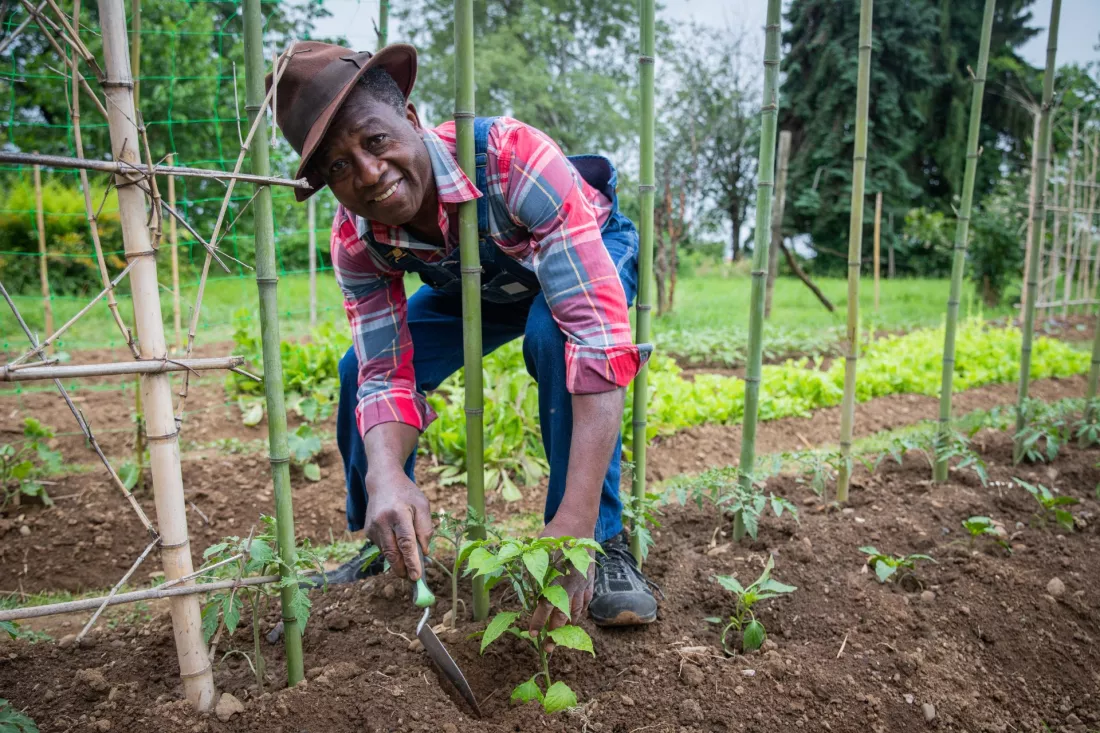
Smallholder farmers in East Africa work plots of less than two hectares, yet they produce up to 70% of their countries’ food. The EU-funded PrAEctiCe project set out to support them by turning agroecology, a broad and rather abstract idea, into concrete indicators that advisors can use on real farms. The tools were piloted in living labs in Kenya, Uganda and Tanzania — and at the end you can check how well you have followed agroecology from idea to numbers.
The scale is striking. According to a CORDIS article published in September 2026, smallholder farmers in East Africa cultivate plots smaller than two hectares, but together they produce up to 70% of their country’s food. What happens on these small farms therefore matters for entire national food systems.
The PrAEctiCe project (Potentials of Agroecological practices in east Africa with a focus on Circular water-energy-nutrient systems) was designed with exactly these farmers in mind. It is coordinated by Karlsruhe University of Applied Sciences in Germany.
The key word of the project is agroecology. Jan Hoinkis, the researcher at Karlsruhe University of Applied Sciences who coordinates the group behind PrAEctiCe, offers a clear definition: “Agroecology means productive, sustainable, resilient and environmentally safe farming and food systems that combine indigenous knowledge with cutting-edge science.”
The definition sounds convincing, but it leaves an obvious question open. How does a farmer, or the person advising that farmer, know whether a particular change on a particular plot actually brings the farm closer to that ideal?
This is where the project comes in. “Our goal is to move agroecology from a broad concept towards an operational, evidence-based decision framework that can support real farm-level choices,” Hoinkis explains.
The result is an actionable decision support tool built for agricultural advisors. Instead of general principles, it offers practical, measurable metrics that can guide what is done on the farm.
The framework puts special emphasis on circular systems in diversified farms that combine crops, livestock and aquatic production. It includes an integrated indicator for assessing farming approaches and an impact quantification tool. Together they look at:
According to Hoinkis, this focus is what sets the work apart: “This is unique as these are areas that had not been sufficiently captured in existing agroecology indicator frameworks.”
The tools did not stay on paper. They were piloted in three East African countries through living labs. Each lab worked in its own way:
The figures describe different groups – farmers in Kenya, stakeholders in Uganda, people in general in Tanzania – so they show the reach of each lab rather than a direct comparison.
One of the less visible results of PrAEctiCe is the community built around it. The project brought together researchers, farmers, advisors, civil society actors, small and medium-sized enterprises and public stakeholders from across Europe and Africa.
Hoinkis sees this as a result in its own right: “This network itself is an important outcome because the agroecological transition requires more than technical solutions – it requires trust, local knowledge, training and institutional uptake too.”
The work continues after the pilot phase. The researchers are now developing the tools further, with a view to scaling them up, refining them and bringing them to market. The living labs are meant to grow into local innovation hubs.
“I’m confident that we will continue to expand on PrAEctiCe’s legacy of making the agroecological transition more measurable, practical and locally grounded for East African smallholder farming,” says Hoinkis.
Farmers with less than two hectares produce up to 70% of the food in their East African countries. PrAEctiCe turned the broad idea of agroecology into a decision support tool for advisors that measures the reuse of water, energy and nutrients, environmental impact, resource efficiency and financial viability. The tools were tested in living labs in Kenya, Uganda and Tanzania, and the network of people behind them turned out to be just as important as the technology.
5 questions · one minute


 EN
EN 
 CS
CS DE
DE ES
ES FR
FR HU
HU IT
IT PL
PL PT
PT РУ
РУ SK
SK TR
TR УК
УК AR
AR 中文
中文