
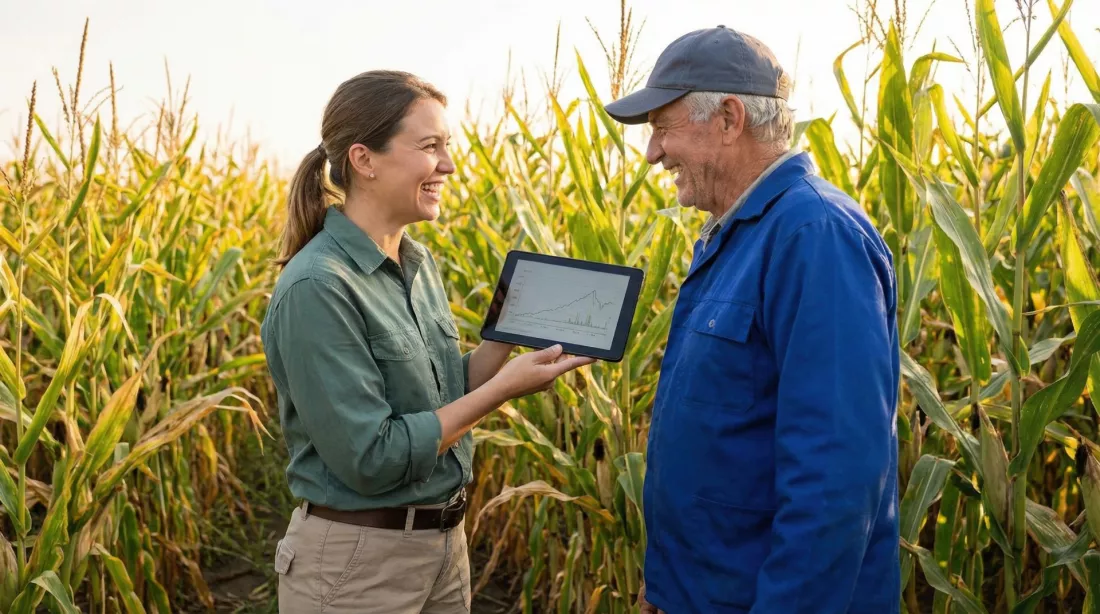
The soil is weakening, water is short and nature is losing its diversity, yet green change in farming moves at a snail’s pace. The European project VISIONARY examined in eight countries what really drives farmers, consumers and food businesses. It turned out that knowledge alone is not enough, that the rules of the game and trust count, and that Danish farmers feared an emissions tax more than they needed to. At the end you can check how you make decisions when changing your habits is at stake.
Soil degradation, water scarcity and disappearing biodiversity: this is the set of troubles farming systems across Europe face today. The conclusion seems obvious: policymakers and businesses should switch to more sustainable practices. Yet there is a wide gap between what should be done and what is actually done.
Researchers from the EU-funded project VISIONARY decided to measure that gap. They wanted to understand what actually guides farmers, consumers and food businesses when they have to choose between what is familiar and what is better for the environment.
The project coordinator, Dionisio Ortiz Miranda, a professor at the Polytechnic University of Valencia, points to a gap in earlier research. As he explains, most of it focuses either on the behaviour of individuals or on broader structural conditions, and only “rarely both at once”.
VISIONARY set out to bring these perspectives together. On the one hand, the team used choice experiments, a method that reveals people’s preferences indirectly, without asking them outright what they value. On the other, it analysed the whole value chain of the agri-food sector: the relationships between market actors, supply chain dynamics and the policy environment.
The research was carried out in eight countries:
The experiments covered climate, biodiversity, water management and organic farming. The systems framework, in turn, was meant to show how relationships between actors and policy rules speed up or slow down change.
The case studies from Italy and Denmark proved especially interesting. In both countries the researchers examined how dairy and livestock farmers respond to tools meant to reduce greenhouse gas emissions.
In Italy, farmers were more willing to accept innovative voluntary carbon markets when these were combined with traditional subsidies. Ortiz Miranda sums it up this way: “hybrid approaches can build trust by integrating innovation and familiarity”.
Sounds familiar? Something new is easier to swallow when it arrives alongside something tried and tested.
In Denmark the issue was a tax on CO2-equivalent emissions. It turned out that farmers greatly overestimated its economic impact, which caused strong resistance from the start. When they were given expert information on the predicted impacts, resistance partly eased and acceptance rose modestly.
Not for everyone, though. Responsiveness was weakest among larger farms and livestock producers, and among those with the largest gaps between their own expectations and expert estimates.
The case studies showed that climate policy in agriculture must put farmers’ perspectives and their actual responses at the centre. Three consistent findings came back across all the studies.
First, information alone is not enough. Ortiz Miranda says that “Inadequate access to relevant information pushes people towards unsustainable decisions”, but better information rarely changes behaviour unless the rules and structures around decision-making also shift.
Second, the whole chain matters. A real transformation requires policies that cover the entire value chain, not just a single farm.
Third, relationships beat one-off actions. Trust, shared responsibility and long-term partnerships between producers and consumers consistently gave better results than one-off interventions.
The researchers also noticed a gap. Behavioural interventions have so far been tested mostly on farmers and consumers, and rarely on the intermediaries in the food chain. According to Ortiz Miranda, extending these tools to the actors operating between the field and the shop “represents a significant opportunity” for future policy.
The most tangible legacy of VISIONARY is its 16 science-policy interfaces. These are participatory spaces in which policymakers, scientists, practitioners and civil society groups co-design solutions together, at local, regional and national levels. The topics discussed there included organic farming, plant-based diets, short supply chains and climate. In several cases the work led to concrete agreements and actions that went beyond the aims of the project itself.
In the authors’ view, combining experimental rigour, systems thinking and stakeholder engagement from the very beginning produces not only better research results but also the conditions for change on a large scale.
Green change in farming does not stall because people do not know what to do. It stalls because the rules of the game, the balance of power in the supply chain and a lack of trust can block even the best intentions. For a student, a future economist, agronomist, sociologist or civil servant, this is an important lesson: effective change is born where the new goes hand in hand with the familiar, and where people build relationships for the long run.
5 questions · one minute


 EN

 CS
 DE
 ES
 FR
 HU
 IT
 PL
 PT
 РУ
 SK
 TR
 УК
 AR
 中文