
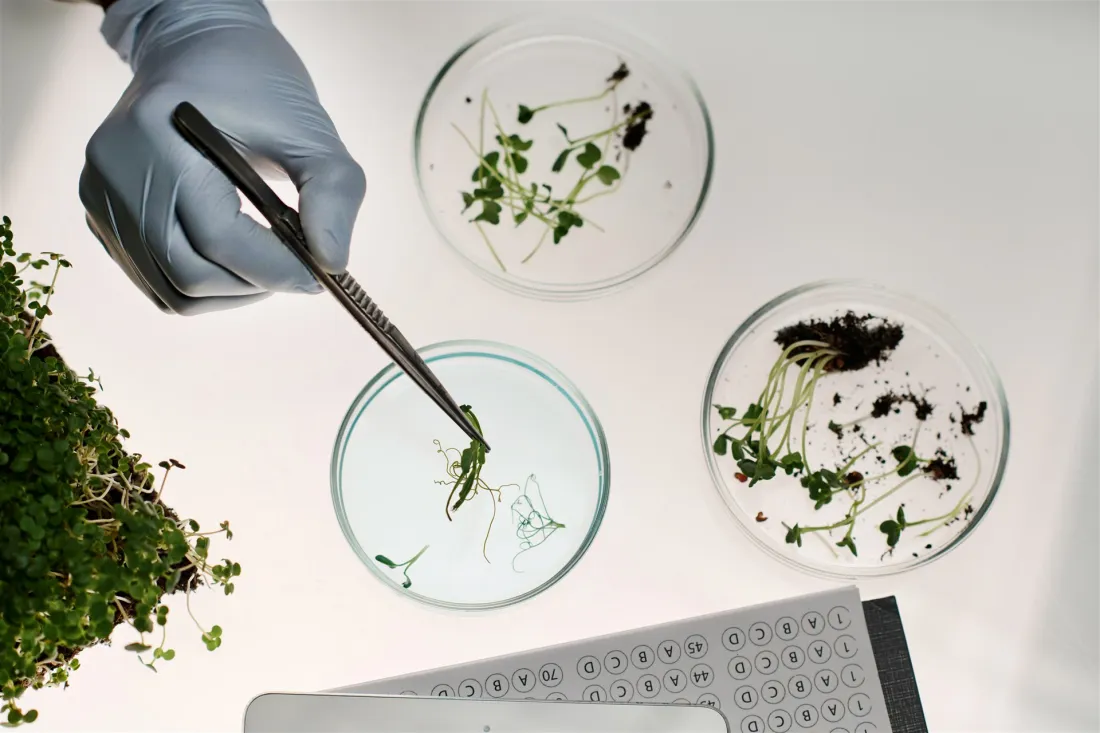
Fungi and bacteria can destroy a huge share of harvests, and for generations farmers have fought back with chemicals. Yet plants have their own immune system – complete with an alarm, soldiers and a safety off-switch. European researchers examined how it works inside a single cell and what this could mean for farming with fewer pesticides. Read what they found out, and at the end take a short test to see how much you remember.
Fungal and bacterial infections destroy up to 40% of crops every year. For generations, farmers have tried to protect their fields with chemical plant protection products, known as pesticides. These help to ensure food security, but they are indiscriminate: they harm not only pathogens but also other organisms and the environment as a whole.
That is why the Farm to Fork strategy, a key pillar of Europe’s Green Deal, aims to reduce pesticide use by 50% by 2030. Simply cutting back on chemicals is not enough – an entirely new approach to making crops more resilient is needed. One promising lead is to look at how plants deal with infections on their own.
This is exactly what the team behind the ImmunoZoneHubs project set out to do, with funding from the Marie Skłodowska-Curie Actions (MSCA). This EU programme supports research and the development of researchers at different stages of their careers, often at institutions abroad. The team decided to look inside individual cells and see how specific proteins and so-called marker genes react to threats.
The goal was twofold. First, to better understand the natural defence mechanisms of plants. Second, to use this knowledge to develop strategies that make it possible to reduce pesticide use in agriculture.
The researchers chose Arabidopsis thaliana for their work. It is a small plant native to Europe and widely used in research on the cell biology of plants. Biologists call it a model organism – a species used to study phenomena shared by many other organisms, so that the findings can later be applied more widely.
Arabidopsis is well suited to this role for several reasons: it is easy to cultivate, has a rapid lifecycle and a small genome. In practice, this means that many generations can be grown in the lab in a short time, and it is relatively easy to track what happens to specific genes.
Fun fact: the unassuming Arabidopsis belongs to the mustard family – the same family as cabbage, broccoli and radishes. Discoveries made on this “weed” could therefore also help the plants that end up on our plates.
To understand immune responses in Arabidopsis cells, the team combined several fields. It used techniques from:
This combination allowed the researchers to understand the mechanisms that enable plants to identify and fight off infections. It is a good example of how modern biology is rarely the work of a single specialism – more often it takes a team of people with different skills.
The immune response in plants, as in animals, requires cells to recognise a pathogen and destroy it. Plants, however, have no immune cells circulating through the body, so every cell has to be able to defend itself. One of their strategies is programmed cell death: an infected cell “sacrifices itself” so that the pathogen does not spread any further.
This mechanism involves more than just the cells that are already infected. It also applies to cells that have restructured in response to the pathogen and are immunologically on high alert. It is a bit like a protective zone around the centre of an outbreak.
A key role here is played by the protease metacaspase 1 (MC1). Proteases are enzymes that cut other proteins, which means they can either disable or activate them. The researchers found that when the immune system is activated, MC1 shifts location in the cell and interacts with key components of the immune system. As a result, it effectively amplifies cellular immunity signalling.
There is a catch, though. Cells in this state can trigger an autoimmune response if left unchecked – in other words, they can start attacking the plant itself. So the organism must be able not only to switch the alarm on, but also to switch it off.
This is where autophagy comes in – an internal recycling mechanism that allows the cell to break down and reuse unnecessary or damaged components. As MSCA fellow Laia Armengot explains: “These MC1 macromolecular hubs are subsequently targeted and degraded by the plant’s internal recycling machinery, autophagy.”
According to the researcher, this process reveals a homeostatic “off-switch” that dismantles the cell death trigger once the threat is contained. Homeostasis is an organism’s ability to maintain balance – in this case, the balance between effective defence and destroying its own tissues.
The second important element is marker genes. A marker gene is one whose activity serves scientists as a signal – an indicator of what is happening in the cell. Such genes play a crucial role in determining immunity-related cell death.
“A key outcome of the project is the functional characterisation of a marker gene that serves as a reliable indicator of cellular suicide commitment,” says Armengot. The team also identified novel enzymatic activities and functions inside the cell that regulate life-or-death decisions in response to environmental stresses, such as pathogen attack.
The next step is to examine closely how marker genes and MC1 hubs work, both in model plants and in agricultural crops. If this succeeds, the project’s findings could transform food production in Europe. “By understanding how plants naturally restrict cell death zones and switch off immune cascades,” Armengot notes, “breeders can design ‘smarter’ crops.”
Importantly, the mechanisms described are universal and not specific to any particular pathogen. This opens up several possibilities:
Research like ImmunoZoneHubs brings together biology, biotechnology and agriculture. These are fields where graduates in biology, biotechnology, horticulture or agriculture work, as well as bioinformaticians who analyse genetic data. Protecting plants without excessive use of chemicals is one of the challenges European agriculture will face in the years ahead.
Plants defend themselves against pathogens by sacrificing infected cells, and the MC1 protein amplifies this alarm. To keep the defence from turning against the plant, autophagy acts as a safety off-switch. Knowledge of these mechanisms, and of the marker gene that reveals a cell’s readiness for sacrifice, could help breeders develop more resilient crops and reduce pesticide use.
5 questions · one minute


 EN

 CS
 DE
 ES
 FR
 HU
 IT
 PL
 PT
 РУ
 SK
 TR
 УК
 AR
 中文