
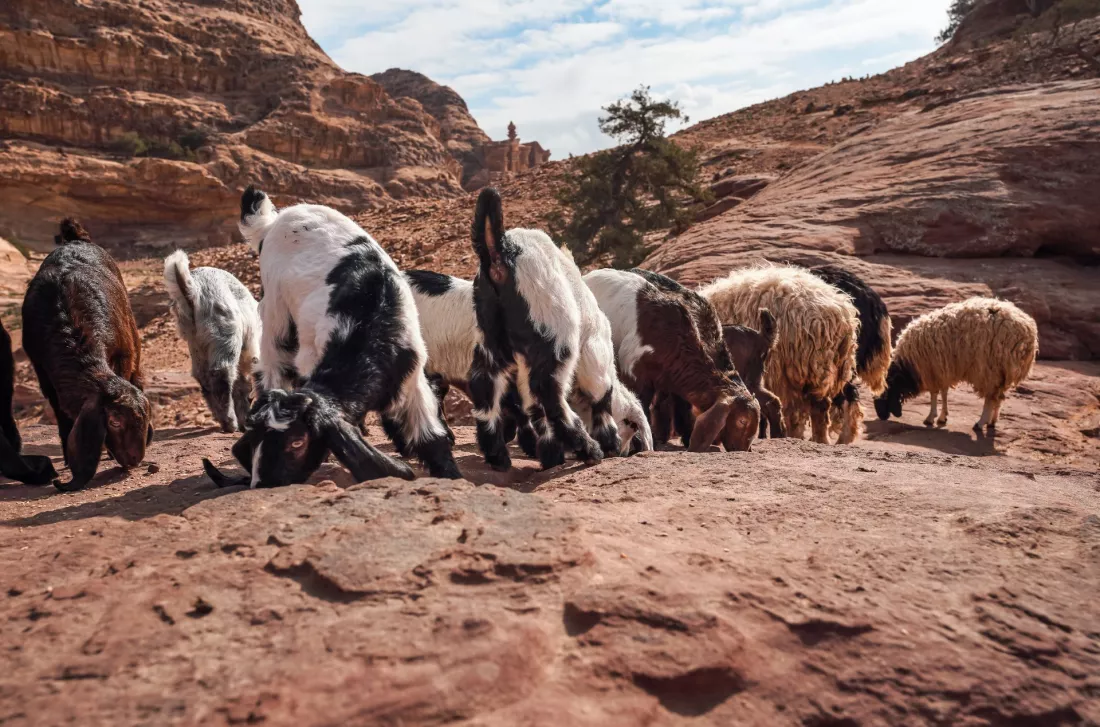
Heat, drought and shrinking water supplies are not just problems of our time. Herders in the Levant faced similar challenges more than 10 000 years ago. The EU-funded ICARHUS project set out to learn how they managed their herds, using a method that reads proteins preserved in ancient animal remains. It turns out that the age and sex of goats and sheep can say a lot about the climate of the past – and at the end you can find out whether there is a Stone Age herder in you.
Rapid climate change is one of the most urgent issues of our time, not least because it seriously affects food production around the world. Yet this is not the first time humans have had to adapt to a changing environment. People in the past also had to cope with warmer temperatures and decreasing water supplies.
That is why researchers look back in time. Learning how earlier communities responded to such conditions offers insight into how we might adapt to changing climate conditions today. This was the idea behind ICARHUS, a project funded by the Marie Skłodowska-Curie Actions (MSCA). Its team used palaeoproteomics, a new molecular technique, to shed light on herding practices in the Levant over 10 000 years ago.
The Neolithic was the era of farming and the domestication of animals, two developments that led to the rise of permanent human settlements. To understand these important moments in human history, researchers rely on material remains found at archaeological sites.
ICARHUS focused on four such sites in Jordan, examining the remains of pastoral societies from 14 000 to 8 000 years ago. This wide range of dates stretches from the earliest stage of domestication to a far more advanced stage thousands of years later. As a result, it offers a window on how animal husbandry practices evolved over time.
The sites have another advantage. They encompass the drier, warmer years that followed the Younger Dryas, an abrupt period of cooling in the Northern Hemisphere. That makes them a good place to study how prehistoric humans faced climate change.
MSCA Fellow Louise Le Meillour explains why this context matters: “Little is known about concrete human adaptation to climatic changes in the past. Getting more insights about where populations settled and how they exploited their environment can help current populations subject to temperature increase, decreasing water supplies and the rapid climate change we are experiencing across the globe.”
Archaeological artefacts such as the bones of domesticated animals can teach us a lot about the biological and cultural history of prehistoric societies. Unfortunately, the arid conditions of the Levant have left few remains behind.
On top of that, other advanced analytic tools, including ancient DNA technologies, are not effective there. The team needed a different approach.
That approach was palaeoproteomics. The method analyses protein sequences left behind on a surprising variety of artefacts, including:
Le Meillour describes what the team used it for: “Within ICARHUS, we used palaeoproteomics to generate data related to gazelles, for which little is known biologically, as well as age and sex-driven caprine herd management strategies of populations subject to climate change,” she explains.
Human selection of species, age and sex is directly influenced by climate. This means that the remains of goats and sheep work almost like a record of the choices herders once made. Two examples show how to read it:
ICARHUS is the first project ever to try to understand early herding strategies by determining the sex of sheep and goat remains. Just like modern humans, prehistoric communities faced climate-related challenges.
By studying how they managed their herds in the face of ecological constraints, researchers can better understand the options before us in a rapidly warming world. Old bones and dental plaque thus become a source of knowledge that is useful today.
Thousands of years ago, herders in the Levant dealt with heat and shrinking water supplies, and their decisions left traces in animal remains. The ICARHUS project reads those traces with palaeoproteomics, which works where ancient DNA technologies fall short. The age and sex of goats and sheep show how people adapted their herds to local conditions – and offer clues about how to think about adapting to climate change now.
5 questions · one minute


 EN
EN 
 CS
CS DE
DE ES
ES FR
FR HU
HU IT
IT PL
PL PT
PT РУ
РУ SK
SK TR
TR УК
УК AR
AR 中文
中文