
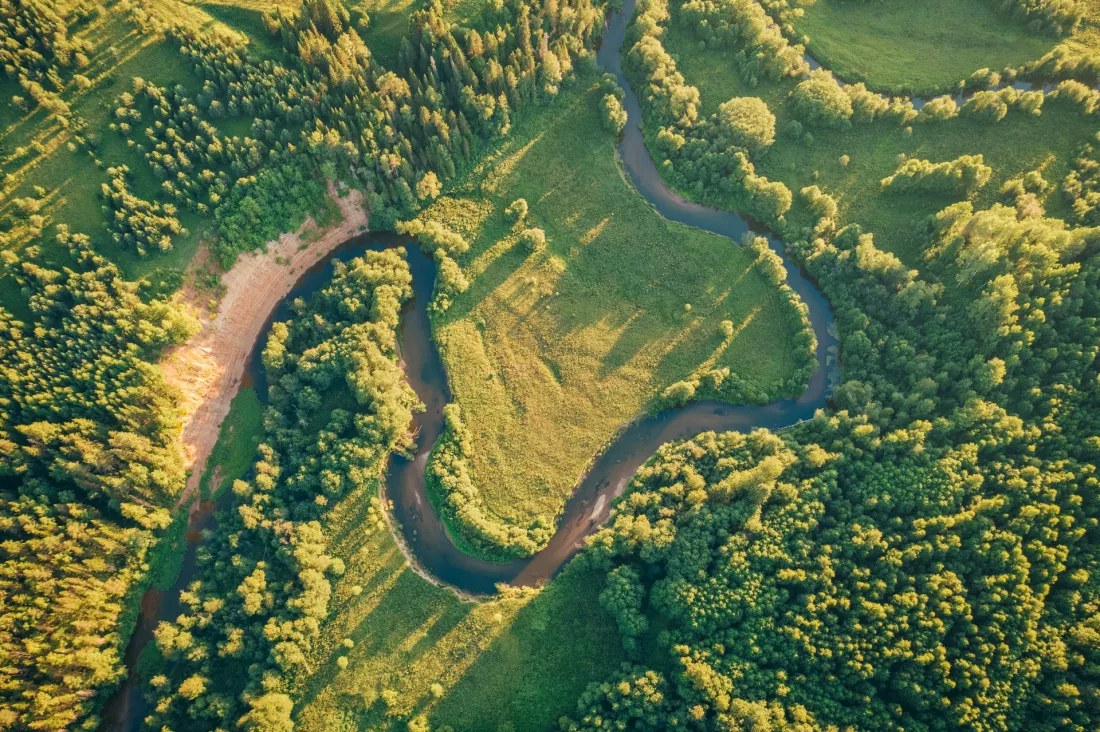
Rivers and peatlands can be given back to nature — and not just in single stretches, but on a large scale. The European MERLIN project put this to the test at 18 sites, from Germany’s Emscher river to drained peatlands in Finland. Yet the most interesting finding is not about excavators or technical drawings, but about people: success more often depends on how authorities, companies, organisations and scientists from different fields get along — and at the end you can check how you would fare in such a team.
Biodiversity loss, climate change and water security problems usually end up in separate drawers. The team behind the EU-funded MERLIN project decided to find out whether they can be tackled at the same time. The idea was simple to describe and hard to carry out: to restore freshwater ecosystems — rivers, wetlands and peatlands — to a natural state on a large scale.
The project ran for more than four years and its total cost exceeded 22 million euros, most of it covered by the EU. It was coordinated by Sebastian Birk of the University of Duisburg-Essen in Germany.
MERLIN brought together 47 partners. Together they implemented and assessed restoration actions at 18 demonstration sites in different parts of Europe. The makeup of the team was itself interesting, because it was not made up only of natural scientists. It included:
On top of that came cooperation with practitioners, public authorities, NGOs and businesses. The coordinator stresses that this combination was the key. “Bringing together scientific expertise with the practical experience of those planning and delivering restoration allowed MERLIN to develop solutions that are scientifically robust, grounded in real-world experience, and directly relevant for policy and practice,” says Sebastian Birk.
One example is the German river Emscher. Sections of it were transformed into functioning ecosystems. The effects show up in several places at once: the risk of flooding fell, water quality improved, and local residents gained a better quality of life. It is good proof that nature and people’s interests need not stand on opposite sides.
Work at Komppasuo in Finland looked quite different. There the focus was on drained peatlands where the natural water level was restored. As a result, peatland habitats began to recover and biodiversity increased. There is also a climate angle: degraded peat soils emit greenhouse gases, and rewetting helped reduce those emissions.
The researchers did not limit themselves to watching nature. They monitored biodiversity, how ecosystems function and which services they provide, and at the same time carried out economic, policy and governance analyses. “This integrated approach allowed MERLIN to assess not only whether restoration works ecologically, but also how it can be implemented effectively, financed sustainably and scaled up across Europe,” explains the coordinator.
Restoring ecosystems costs money, so the team looked for ways to diversify funding. Instruments that can be applied right away came under scrutiny: green bonds, blended finance and payments for ecosystem services.
The project also created the Zero Risk Nature Acceleration Programme. It offers mentoring tailored to a specific undertaking, help with designing a business model and cooperation with finance experts. The aim is to prepare restoration ideas so that they are ready for investment. The team also identified the conditions that must be met to attract investors. At the same time, it admits that private money in this field is still at an early stage — promising, but a trail not yet well trodden.
In total, 42 actions to restore freshwater ecosystems were carried out across Europe. The most important finding may come as a surprise: the success of restoration depends less on the technical design and more on the governance context, that is, on who makes decisions and how they work together. “This reinforced the importance of viewing ecosystem restoration not simply as an environmental intervention but as a long-term societal endeavour requiring collaboration across sectors and disciplines,” notes Birk.
The results of MERLIN also fed into the debate around the EU Nature Restoration Regulation. The project provided evidence-based guidance meant to help put such solutions into practice more widely.
MERLIN showed that restoring nature to rivers and peatlands benefits wildlife, the climate and local residents all at once. “MERLIN has shown that large-scale restoration is both feasible and beneficial while also highlighting the governance, financing and implementation challenges that still need to be addressed. In that sense, the project has laid important foundations for the next generation of freshwater restoration across Europe,” concludes Sebastian Birk. The takeaway for future specialists is clear: technical knowledge alone is not enough, and the ability to work with people from entirely different fields is just as necessary.
5 questions · one minute


 EN

 CS
 DE
 ES
 FR
 HU
 IT
 PL
 PT
 РУ
 SK
 TR
 УК
 AR
 中文