
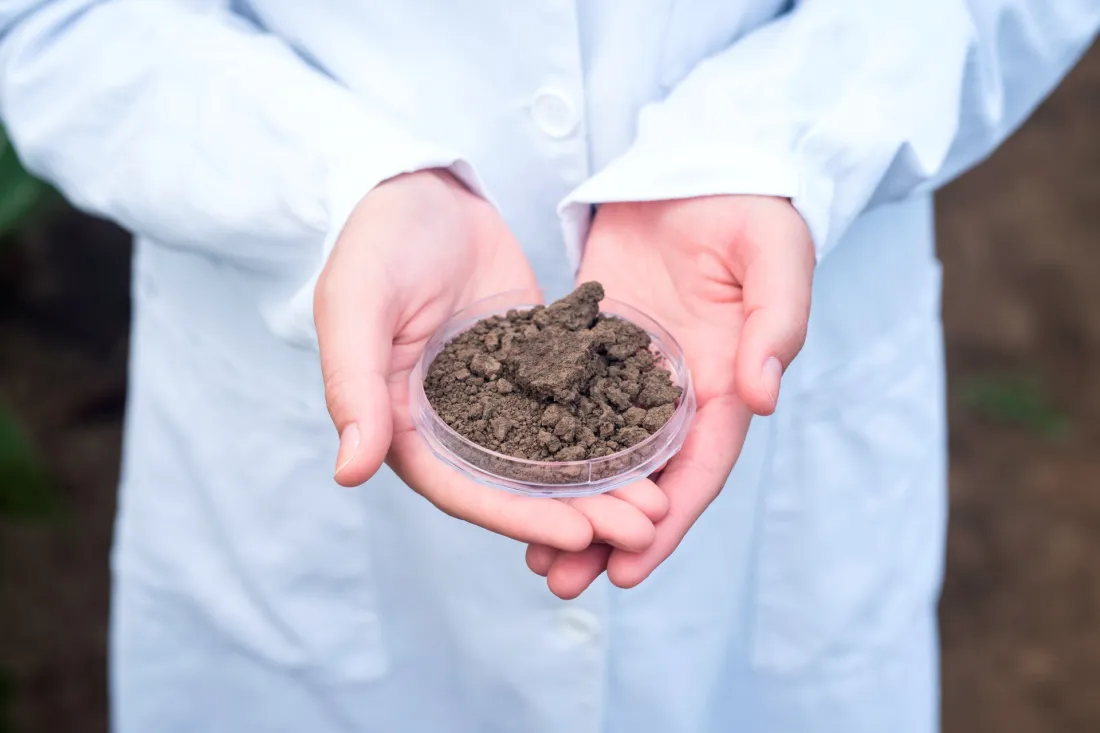
The plastic we throw away does not disappear. It ends up in the environment, including the soil where edible plants grow. Do plants absorb it, and what does that mean for soil fertility? A researcher who has long followed the path of microplastics gives the answer. Read what his team found out, and at the end take a short test to see how much you know about plastic in soil.
“Yes, they do,” says Luca Nizzetto, chief scientist at the Norwegian Institute for Water Research. “This is already a consolidated piece of knowledge in our field.”
Nizzetto studies where the plastics we make end up. In the EU-funded PAPILLONS project, he and his colleagues gathered more evidence on how microplastics affect soil.
Microplastics are tiny particles of plastic, often invisible to the naked eye. They form mostly when larger plastic items, such as films, packaging or bottles, break down under sunlight, water and friction. They reach the soil with waste, through the air and with water, and once they have spread through it, they practically cannot be picked out again.
Small plastic particles can make their way inside plants in several ways:
The openings in leaves mentioned here are stomata – microscopic pores through which a plant takes in carbon dioxide from the air, needed for photosynthesis, and releases water vapour. Roots, meanwhile, keep growing and branching all the time, and every crack in their tissue can become a gateway for tiny particles from the soil.
There is still no full assessment of how much microplastic reaches food this way, or what it means for human health. What we do know is that plants growing in plastic-contaminated soils experience stress, says Nizzetto, as shown by changes in growth and rising levels of stress hormones.
Nizzetto’s team also found a change that should interest consumers. “We noticed that after growing in soil enriched with microplastics, there was a nutritional composition shift from carbohydrates to more proteins.”
What this means for humans, herbivores and the broader soil ecosystem is the subject of much ongoing research.
Carbohydrates and proteins are two basic nutrients of crop plants. Carbohydrates, such as starch and sugars, are the plant’s main energy store, while proteins build its cells. A change in these proportions means that what reaches your plate from a plant grown in contaminated soil may have a different composition than usual.
Nizzetto wrote a systematic review for the Food and Agricultural Organization of the United Nations (FAO) on the impacts of microplastics on soil and plant health. It collected hundreds of papers showing that microplastics change many soil properties, such as its capacity to retain water or cycle nitrogen.
“These are all variables that define soil fertility,” the researcher adds. “For this reason, we brought forward the message that microplastic pollution is a potential concern for food security.”
Why water and nitrogen in particular? How much water the soil can hold determines whether plants cope during a drought. Nitrogen, in turn, is one of the most important nutrients for plants – it circulates in the soil thanks to microorganisms that turn it into forms the roots can use. When either of these processes weakens, plants grow worse.
PAPILLONS produced around 60 scientific studies. Their results helped shape a new EU Soil Monitoring Law. “Initially, microplastics were not considered to be an emerging contaminant concern, but the final approved version of the law explicitly mentions microplastics,” notes Nizzetto.
Removing plastic from soil is not simple. Solvents can remove it, but they may also kill important microbes in the soil. Other technological solutions are being developed too, but their side effects for the broader ecosystem are still unclear.
That is why the researcher puts his faith in prevention. He sees the best solution in mitigation through processes such as regenerative agriculture. “If you have a healthy soil with rich organic matter that can store organic carbon and act also in carbon storage, it will also help mitigate the impact of microplastics,” he explains.
Regenerative agriculture is a way of farming that aims to rebuild the health of the soil, not just to get a quick harvest. Farmers reduce ploughing, do not leave fields bare and look after humus, that is, organic matter, which feeds soil organisms and binds carbon. Such soil copes better with pollution, including pollution that cannot be removed from it.
Fun fact: A single teaspoon of healthy soil holds more microorganisms than there are people on Earth. That is why methods that kill soil microbes while removing plastic can do the soil more harm than good.
Plants absorb microplastics through their leaves and roots, and the particles can reach the edible parts. Plants from contaminated soil live under stress and their composition changes, while the soil itself loses the properties its fertility depends on. It cannot easily be cleaned, so the best approach is to look after healthy soil.
5 questions · one minute


 EN

 CS
 DE
 ES
 FR
 HU
 IT
 PL
 PT
 РУ
 SK
 TR
 УК
 AR
 中文